
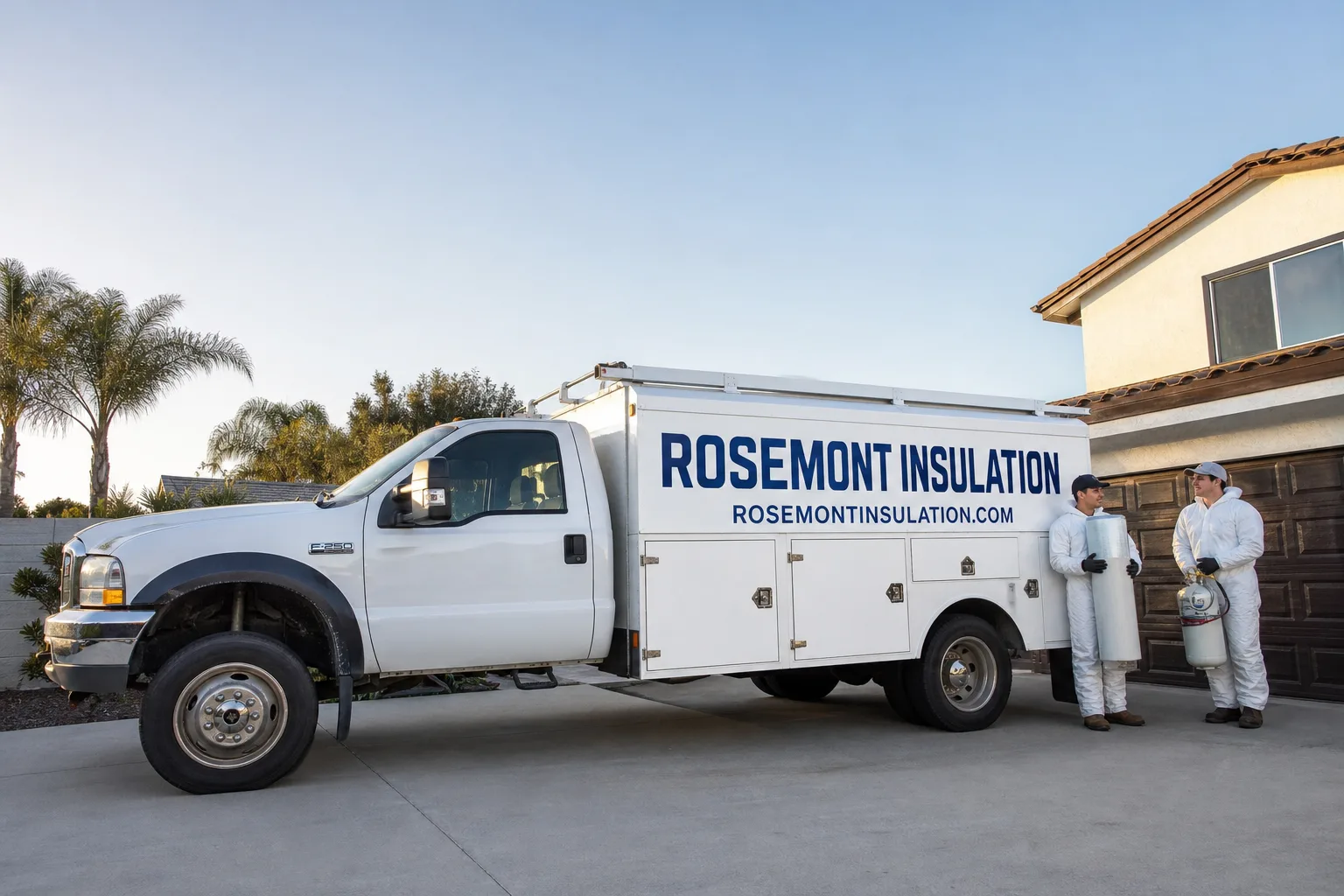
Fast, Reliable Spray Foam Insulation Across Portola Hills
Spray foam insulation in Portola Hills typically costs $2.75 to $6.25 per board foot installed, with a standard garage ceiling project running $1,450 to $2,900 and a full attic air-barrier retrofit in a two-story tile-roof home landing between $4,200 and $9,800. Most of the homes we service in the 92610 corridor are the late-1980s and 1990s Mediterranean-style tracts climbing the hillsides above Lake Forest, which means we know exactly what their vaulted ceilings, concrete tile roofs, and steep pitches do to attic access and heat loads before we even pull up. Noel Carrington and the Spray Foam Insulation team run daily routes into Portola Hills from our Costa Mesa base, and we can usually have a technician at your scuttle within 24 to 48 hours. If you’re sitting under a ceiling that radiates heat by 3 p.m. in July, call (877) 676-3859 and we’ll tell you straight what it’ll take to fix it.
Why Rosemont Insulation Is Portola Hills’s Preferred Spray Foam Insulation Company
We’re the crew that other Portola Hills homeowners call after they’ve had two other companies out and still don’t have a straight answer. The reason is simple: we carry eight insulation brands including Icynene and Demilec, and we don’t push one foam system because it’s what’s on the truck this week. In a hillside community where one house has a 14-inch attic cavity and the next has cathedral ceilings with no cavity at all, that material-agnostic approach is the only honest way to operate. Noel Carrington built the company on matching the foam to the house, not the house to the foam.
We’ve worked enough Portola Hills homes to know the calls by heart: bonus rooms over garages that bake every summer, second-story bedrooms on the west side that never cool down, and scuttle holes so tight nobody wants to touch the job. Our response time to Portola Hills runs 24 to 48 hours for quotes and emergency assessments, and every estimate comes with a written plan that names the specific foam, the depth, and the lift schedule before you commit. We’re state-licensed, insured, and we answer the phone. Call (877) 676-3859 and you’ll get a person, not a call center.
Garage Spray Foam Insulation in Portola Hills
Garage Spray Foam Insulation in Portola Hills almost always means one of two jobs: sealing the shared wall and ceiling between the garage and a finished room above it, or applying foam to the underside of the roof deck to keep the garage itself from becoming an oven. In this community’s two-story Mediterranean tract homes, the bonus room over the garage is a standard floor plan feature, and it’s also the number one heat complaint we hear. The original fiberglass batts from the 1980s and 1990s have settled, compressed, or shifted, leaving a direct thermal bridge from the tile roof above straight into the living space. Closed-cell foam applied in lifts bridges those gaps and restores a continuous air barrier.
Sealing the Garage-to-Bonus-Room Boundary
On a recent cathedral-ceiling home near the Cleveland National Forest edge, our crew used Icynene closed-cell foam to seal the garage ceiling and cantilevered sections where 1990s batt insulation had settled and compressed, creating a persistent hot-spot above the bonus room. We accessed the space through a 16×24-inch scuttle and applied 2 inches of foam to the underside of the roof deck, restoring a continuous air barrier and cutting attic heat gain. That’s the kind of port-of-entry work that generic insulation companies skip, and it costs Portola Hills homeowners $1,450 to $2,900 for a typical two-car garage ceiling.
Under-Roof-Deck Application for Detached and Semi-Attached Garages
Homes on the steeper lots in Portola Hills often have garages built into the slope with little to no attic space above them. Spraying the roof deck directly with closed-cell foam turns that thin air space into conditioned or semi-conditioned volume and drops interior garage temperatures by 15 to 20 degrees in summer. If your garage faces west toward the Santa Ana corridor, this is the single most effective change you can make short of replacing the tile roof. The job runs $2,100 to $5,200 depending on square footage and access.
Closed Cell Spray Foam Insulation in Portola Hills
Closed Cell Spray Foam Insulation in Portola Hills is the heavier-duty option, and for good reason here. It cures rigid, adds structural shear strength, and blocks both air and moisture at roughly R-7 per inch. In a hillside community against the Cleveland National Forest, the moisture-control properties matter as much as the thermal performance. Tile roofs on steep pitches trap humidity under the deck, and when Santa Ana winds drive dry heat against the fire-interface edge, homes with open-cell foam or displaced batts lose conditioned air fast. Closed-cell foam makes sense when you need both heat rejection and a vapor barrier in one pass.
Fire-Interface and Ember-Resistant Applications
Portola Hills sits in the wildland-urban interface, and the tile roofs that dominate the 92610 tracts are part of that fire story. Closed-cell foam applied to the underside of the roof deck can reduce the ember-driven attic ignition pathway, particularly when the existing venting is left intact and sealed correctly at the perimeter. We don’t touch or alter ember-resistant vents; that’s a code and HOA issue here. What we do is seal the interior attic boundary so hot gas and drifting ember sparks can’t find an easy path into the conditioned space.
Structurally Reinforcing Older Hillside Roof Decks
Homes on steep Portola Hills lots put real wind load on their roof assemblies, especially when the Santa Anas kick up out of the canyons. Closed-cell foam adds measurable shear strength to the deck and reduces the racking that older tract homes from the 1980s and 1990s can experience at the gable ends. We apply it in lifts of 1 to 2 inches to prevent over-expansion against drywall in shallow cavities, a failure mode we’ve seen when less experienced crews spray too deep too fast. Closed-cell work in Portola Hills typically lands between $3.50 and $6.25 per board foot installed.
Trusted Brands We Service in Portola Hills
We install and service Portola Hills spray foam systems from Icynene and Demilec, two of the performance leaders in the industry, and we carry CertainTeed and GreenFiber when the job calls for hybrid approaches. We keep open-cell and closed-cell kits stocked for the most common Portola Hills applications, which means we’re not waiting on a distributor shipment when your garage ceiling job is approved. A typical closed-cell roof-deck application using Icynene or Demilec can be scheduled and completed within five to seven business days in the 92610 area. Our installers are factory-trained on both foam brands, and our written quotes specify the exact system so you can check product data sheets before you sign.
Common Spray Foam Insulation Problems We See in Portola Hills Homes
- Settled 1990s batt insulation over garages and cantilevered bays. By the time these homes hit 25 to 35 years old, the original fiberglass over garage ceilings and cantilevered floor sections has compressed or slumped, leaving a hot band you can feel underfoot. Closed-cell spray foam bridges those gaps and adheres to the deck, which batts never did.
- Vaulted ceilings with no attic cavity trapping heat. The cathedral and vaulted ceiling plans all over Portola Hills leave a roof assembly with maybe 4 to 8 inches of space between the ceiling drywall and the roof deck. That makes standard vented insulation methods nearly useless, and spray foam applied from tight interior scuttles is usually the only realistic air-sealing path.
- Over-expansion cracking drywall in shallow cavities. We’ve followed and fixed crews who sprayed closed-cell foam too deep too fast in Portola Hills’s tight ceiling cavities. The foam expands, pushes against the drywall, and you get hairline cracks running across your ceiling. We apply foam in controlled lifts and monitor rise to avoid this entirely.
- Blocked soffit vents creating moisture problems. HOA rules and fire-interface requirements along the Cleveland National Forest edge restrict what venting can be changed on many Portola Hills roofs. Improperly aimed spray foam can block soffit intake vents, which stalls the whole attic ventilation loop and drives moisture into the roof deck. We plan foam placement around existing venting, not over it.
Pricing for Spray Foam Insulation in Portola Hills, CA
Spray foam pricing in Portola Hills runs higher than flatland Orange County cities because access is harder, scuttles are tighter, and the work often happens from interior ladders rather than a roomy attic walkway. Open-cell foam runs $2.75 to $4.25 per board foot installed here. Closed-cell runs $3.50 to $6.25. A garage ceiling with settled batt removal and closed-cell air-barrier work usually lands between $1,450 and $2,900. A full roof-deck air-barrier retrofit on a two-story tile-roof home lands between $4,200 and $9,800 depending on square footage and how much of the original insulation has to come out first. Call (877) 676-3859 for a written quote. Estimates are free, and we itemize the foam type, depth, and lift schedule.
We Also Serve Cities Near Portola Hills
Our routes from Costa Mesa take us through Foothill Ranch, Lake Forest, Mission Viejo, and Laguna Woods, and we treat each city’s housing stock on its own terms. A Mission Viejo flat-ceiling ranch needs a different foam approach than a Portola Hills vaulted-ceiling hillside home. If you’re in any of those communities, call (877) 676-3859 and we’ll schedule the same material-agnostic assessment we do everywhere we work.
Serving Portola Hills, CA — Our Local Coverage Area
We’re based in the Portola Hills area and know this community well. Use the map below to see our service coverage — if you’re nearby, we can almost certainly help.
FAQs About Spray Foam Insulation in Portola Hills
Yes, assuming the scuttle or interior access point can fit a spray gun and the roof deck is reachable from the interior. In Portola Hills homes with vaulted ceilings and cathedral plans, we typically access the roof deck through a small scuttle or ceiling cut and apply closed-cell foam in controlled lifts directly to the underside of the deck. This turns the rafter bay into an unvented assembly and creates an air barrier without needing attic walkway space. The job is more labor-intensive than a standard attic spray, which is why Portola Hills vaulted-ceiling retrofits run higher per square foot than flat-ceiling work. Call (877) 676-3859 and mention your ceiling type for an accurate estimate.
Spray foam reduces the ember-driven ignition pathway by sealing the attic boundary so wind-blown embers and hot gases have fewer gaps to enter the conditioned space. In Portola Hills, where the Cleveland National Forest edge puts homes in the wildland-urban interface, the vents themselves are the weak point, not the insulation, and ember-resistant venting is a separate code requirement we don’t alter. Closed-cell foam applied continuously to the roof deck interior closes off the gaps around light fixtures, top plates, and scuttle edges that embers could exploit. It’s one part of a defensible space and hardening strategy, not a substitute for fire-rated vents and cleared zones. Call (877) 676-3859 if you want us to inspect your attic boundary before fire season.
The best approach is removing or bypassing the settled batts and applying closed-cell foam in lifts to the underside of the garage ceiling or roof deck, depending on whether there’s living space above. Most Portola Hills garage ceilings have a bonus room or bedroom above them, and the settled 1990s batts have left a thermal void that closed-cell foam can bridge and air-seal in one pass. We typically apply 2 inches of closed-cell foam to the roof deck or ceiling plane to restore a continuous air barrier and boost the assembly to roughly R-14 while sealing air gaps. Expect $1,450 to $2,900 for a standard two-car garage in Portola Hills. Call (877) 676-3859 for a floor-plan-specific quote.
It won’t if it’s planned correctly, but poorly aimed spray foam can absolutely bury soffit intake vents and stall attic ventilation, which is a recurring problem we fix in Portola Hills tract homes. The solution on tile-roof homes with steep pitches and limited access is either installing baffles before spraying or keeping foam off the eave line by applying it to the roof deck rafter bays only, not the soffit openings. On fire-interface lots where vent changes are restricted by HOA or code, we work around the existing ember-resistant vents rather than altering them. Your estimate should show a clear foam boundary line relative to your soffits. Call (877) 676-3859 and we’ll map it before any foam leaves the rig.
Tile roofs on steep Portola Hills pitches radiate heat downward into the attic, push attic temperatures well past what flatland neighborhoods see, and force much of the spray foam retrofit to happen from tight interior scuttles rather than standing room in an attic. The tile staples and underlayment also trap moisture against the deck, which makes closed-cell foam’s vapor-blocking properties more valuable here than in coastal cities. And on HOA-governed fire-interface streets, we can’t pop tiles to access the deck from above, so the entire job has to be planned around interior access. It’s slower and more precise work, and our pricing reflects that. Call (877) 676-3859 for a Portola Hills-specific quote.
Written by Noel Carrington, Owner at Rosemont Insulation, serving Portola Hills and the surrounding Orange County foothills.