
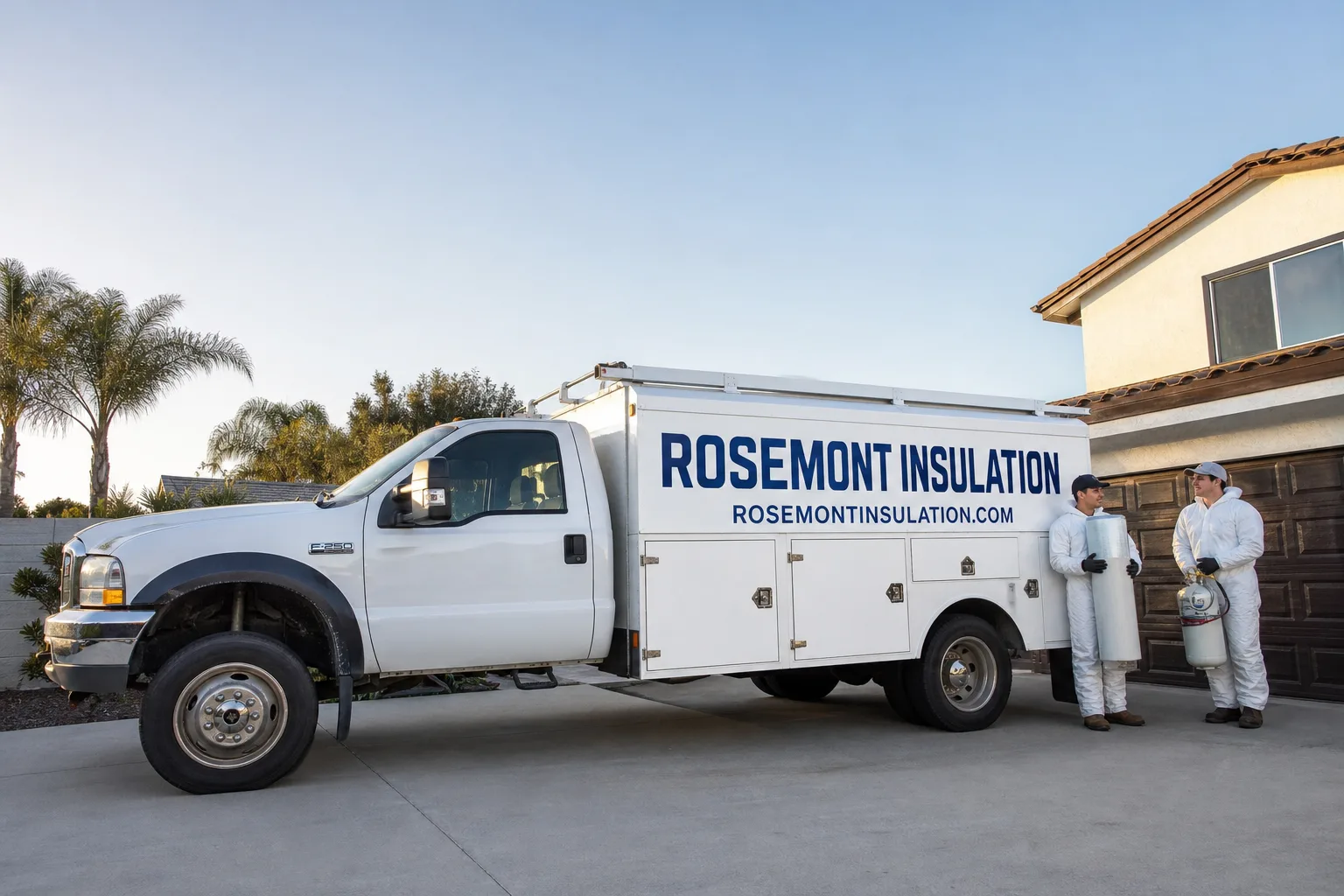
Trusted Spray Foam Insulation for Costa Mesa Homeowners
Spray foam insulation in Costa Mesa typically costs $2.50 to $7.00 per square foot installed, with most whole-home projects landing between $4,500 and $12,000 depending on foam type and square footage. Open-cell runs lower, closed-cell higher. Same-day estimates are available across Costa Mesa, and we install premium systems from Icynene and Demilec, two brands most local contractors don’t carry.
Costa Mesa’s marine layer keeps mornings damp and afternoons dry, which means air sealing matters as much as R-value here. Older tract homes in neighborhoods like Mesa Verde and College Park leak conditioned air through rim joists, attic hatches, and top plates, and that’s exactly what spray foam addresses. We’re led by Noel Carrington, and our crews install spray foam, blown-in, and attic insulation under one roof, so the recommendation is tied to your home’s actual performance, not what’s easiest to stock. Call (877) 676-3859 for a free estimate.
Key Takeaways:
– Spray foam in Costa Mesa runs $2.50 – $7.00/sq ft installed
– Open-cell is best for attics and interior walls; closed-cell for crawl spaces and rim joists
– We carry Icynene and Demilec, two premium spray foam brands
– Same-day estimates and fast scheduling across Costa Mesa
Closed Cell Spray Foam Insulation
Closed Cell Spray Foam Insulation is a dense, rigid foam that cures at roughly 2 pounds per cubic foot, creating both an air barrier and a vapor barrier in a single application. It’s the right call when you need high R-value per inch (around R-6.5 to R-7), structural reinforcement, or moisture resistance, which makes it ideal for Costa Mesa crawl spaces, rim joists, and foundation walls where damp coastal air is a year-round concern. Rosemont Insulation installs closed-cell systems from Demilec, one of the most performance-tested closed-cell formulations in the industry. Expect closed-cell to run $3.50 to $7.00 per square foot installed in Costa Mesa.
Moisture Control Application
Closed-cell acts as a Class II vapor retarder, which matters in Costa Mesa’s coastal climate where morning fog and humidity push moisture into framing cavities. In crawl spaces under Mesa Verde and Eastside homes, closed-cell stops damp air from condensing against floor joists. It’s the only spray foam we recommend for direct ground-contact applications.
Structural R-Value Discussion
At R-6.5 to R-7 per inch, closed-cell delivers nearly double the thermal performance of open-cell in the same cavity depth. That matters when wall cavities are limited to 2×4 framing and you’re trying to hit California Title 24 energy code targets. It also adds racking strength to walls, which helps older Costa Mesa homes built before modern shear-wall standards.
Open Cell Spray Foam
Open Cell Spray Foam is a lighter, lower-density foam that cures at about half a pound per cubic foot, designed primarily for air sealing and sound dampening rather than vapor control. It’s the better choice for attics and interior walls in Costa Mesa because it’s vapor-permeable, meaning it lets moisture pass through rather than trapping it, which keeps roof decks from rotting in our damp coastal air. Rosemont Insulation installs Icynene open-cell systems, a premium brand with a long track record in humidity-heavy climates. Open-cell typically runs $2.50 to $4.50 per square foot in Costa Mesa.
Attic Air Sealing Performance
Open-cell excels at filling irregular cavities: the gaps around recessed lights, top plates, and plumbing penetrations where warm air escapes in winter and hot air pushes in during summer. We apply it to the roofline itself in Costa Mesa attics, creating a conditioned attic space that keeps ductwork from sweating. This single change often cuts cooling bills noticeably during August and September heat waves.
Sound Control Benefits
The soft, spongy texture of open-cell absorbs sound better than any batt or rigid board. For Costa Mesa homes on busy streets like Baker Street or near John Wayne Airport’s flight paths, we use open-cell in interior walls and floor cavities to dampen noise transfer. It’s a meaningful quality-of-life upgrade that also happens to air-seal the wall assembly.
Spray Foam Insulation Contractors
Spray Foam Insulation Contractors are licensed insulation specialists trained in the application of two-component foam systems, and the difference between crews shows up immediately in application quality, off-ratio foam, and long-term performance. Hiring the right contractor matters because spray foam is unforgiving: a bad mix or an uneven lift can leave voids that no amount of re-insulating fixes cleanly. Rosemont Insulation is a material-agnostic specialist carrying eight brands across three insulation methods, so our crews are trained on both open-cell and closed-cell chemistry from Icynene and Demilec. We don’t push one product because we genuinely stock the full range, which changes the quality of the recommendation you get.
Certification and Training
Our applicators are certified to install Icynene and Demilec systems, which means they’ve been trained on the specific mix ratios, temperature windows, and lift-thickness rules for each product. In Costa Mesa’s coastal climate, those temperature windows matter: spraying foam when substrate temps are too low produces off-ratio foam that never fully cures. We monitor substrate temperature before every application, which is the kind of detail that separates a warranty-backed install from a call-back.
Scheduling and Scope
Most Costa Mesa spray foam projects go from estimate to completed install within five to seven business days. We handle prep, masking, spraying, trimming, and cleanup as a single scope, so you’re not coordinating multiple subs. The estimate process includes a full cavity inspection and an honest conversation about whether spray foam is the right product for your specific problem, because sometimes it isn’t.
Spray Foam Attic Insulation
Spray Foam Attic Insulation refers to applying open-cell or closed-cell foam directly to the underside of the roof deck, creating an unvented, conditioned attic that stays within a few degrees of the living space below. In Costa Mesa, this is the single highest-impact insulation upgrade because unconditioned attics routinely hit 130 degrees in summer, cooking any ductwork running through them. Rosemont Insulation installs spray foam attic systems using Icynene open-cell in most cases, with closed-cell specified when the roof deck shows signs of moisture exposure. Plan on $3,500 to $9,000 for a typical Costa Mesa attic depending on square footage and foam type.
Conditioned Attic Conversion
Converting a vented attic to a conditioned attic means sealing off gable vents, soffit vents, and ridge vents before spraying. The payoff is immediate: your HVAC ducts stop losing thermal energy to a superheated attic, and the air handler doesn’t have to work as hard to push cool air through the house. Costa Mesa homeowners with upstairs bedrooms over garage spaces see the biggest comfort gains.
Duct Performance Improvement
In a typical Costa Mesa home, ducts lose 20 to 30 percent of conditioned air through leaks and thermal transfer in the attic. Spray foam at the roofline brings those ducts inside the thermal envelope, which means the air coming out of your registers is the same temperature as the air leaving the unit. It’s the closest thing to moving your HVAC system indoors without actually relocating equipment.
Spray Foam Wall Insulation
Spray Foam Wall Insulation is applied into wall cavities during construction or through injection methods in existing homes, filling the entire cavity from bottom plate to top plate for continuous thermal and air sealing. It’s the right solution for Costa Mesa homeowners renovating kitchens, bathrooms, or additions where walls are already open, and for existing walls, we use slow-rise injection foam to fill cavities without tearing out drywall. Rosemont Insulation handles both new-construction wall applications and retrofit injection projects using Demilec closed-cell or Icynene open-cell depending on the cavity depth. Wall spray foam in Costa Mesa typically runs $3 to $6 per square foot of wall area.
New Construction and Renovation
When walls are open during a remodel, spray foam fills every irregular void: plumbing chases, electrical boxes, and corner framing that batts can’t reach. This creates a monolithic air barrier that eliminates the thermal bypasses common in Costa Mesa tract homes built in the 1960s and 70s. We coordinate with your general contractor’s framing schedule to spray before drywall goes up.
Retrofit Injection Method
For finished walls, slow-rise injection foam expands gently into the cavity through small holes drilled at each stud bay. This works well for Costa Mesa homeowners with uninsulated walls who don’t want to open up drywall in every room. The foam fills the cavity and air-seals it in one pass, and we patch the injection sites cleanly when we’re done.
Rim Joist Spray Foam
Rim Joist Spray Foam targets the perimeter band board where your floor framing meets the foundation wall, one of the most consistently overlooked air-leakage points in Costa Mesa homes. In a typical two-story tract home, rim joists account for a surprising share of the total air leakage, because the fiberglass batts stuffed into those cavities sag, fall out, and leave gaps. Rosemont Insulation seals rim joists with closed-cell foam, which air-seals and insulates in a single application. Rim joist sealing in Costa Mesa runs $1,500 to $3,000 for a full perimeter, depending on access and home size.
Air Leakage Assessment
We check every accessible rim joist bay during the estimate: from the crawl space below, from the basement if you have one, and from the garage where the band board is often exposed. What we find in Costa Mesa homes is consistent: the original insulation has settled, pests have tunneled through it, and there’s visible daylight at the sill plate. Closed-cell foam eliminates all three problems.
Crawl Space Connection
Rim joist sealing goes hand-in-hand with crawl space encapsulation. Without it, a sealed crawl space still leaks air around the perimeter where floor joists sit on the foundation wall. We treat the rim joist as part of the crawl space envelope, not a separate scope, so the air barrier is continuous. This is one of the highest-ROI improvements in our home performance repertoire.
Crawl Space Spray Foam Insulation
Crawl Space Spray Foam Insulation applies closed-cell foam to the crawl space walls and rim joists rather than the floor above, bringing the crawl space inside the home’s thermal envelope. Costa Mesa’s coastal humidity makes vented crawl spaces a liability: warm, moist air enters through foundation vents, condenses on cool floor joists, and feeds mold and wood rot. Rosemont Insulation installs crawl space systems using Demilec closed-cell foam, sealing the foundation walls from sill plate to dirt line. A typical Costa Mesa crawl space encapsulation with spray foam runs $5,000 to $10,000.
Encapsulation Scope
The full scope includes sealing foundation vents, spraying closed-cell on the perimeter walls and rim joists, and installing a vapor barrier on the floor if one isn’t already present. The result is a dry, clean crawl space that no longer exchanges air with the outside. For Costa Mesa homes with hardwood floors above the crawl space, this also stabilizes interior humidity, which reduces cupping and gap between boards.
Humidity Control Effects
Costa Mesa’s average relative humidity hovers around 70 percent year-round, which means any crawl space open to outside air is always damp. Closed-cell foam at two inches thick acts as a vapor barrier at the wall, cutting off the primary moisture entry path. Most homeowners notice the difference in musty smells within days of the install, and the floors above feel warmer in winter.
Garage Spray Foam Insulation
Garage Spray Foam Insulation focuses on the shared wall between the garage and the living space, along with the garage ceiling and rim joists, to stop garage temperatures from bleeding into your home. In Costa Mesa, attached garages face south and west on most lots, turning them into convection ovens by mid-afternoon, and that heat pushes through the common wall into bedrooms and hallways. Rosemont Insulation insulates garage walls and ceilings with open-cell or closed-cell foam depending on whether the garage stays unconditioned. Expect $2,000 to $5,000 for a full attached-garage scope in Costa Mesa.
Shared Wall Treatment
The wall between your garage and your living room is often the worst-insulated wall in the house. Builders treat it as an interior wall, which means it gets minimal insulation, and the garage side stays unconditioned. We spray the garage-side stud cavities with closed-cell foam, which air-seals against car exhaust and fires up the wall’s thermal performance without touching the finished living space.
Ceiling and Rim Joist Scope
For garages with bedrooms above, the ceiling cavity is just as important as the shared wall. We spray the garage ceiling with open-cell foam, which damps the sound of the garage door opener while cutting heat transfer into the room above. We also treat the garage rim joists, which are usually accessible from inside the garage and rarely insulated at all in Costa Mesa homes.
Brands We Service
We install Icynene open-cell spray foam, specifically the Classic Max and ProSeal lines, because these formulations have a decade-plus track record in coastal humidity environments like Costa Mesa. Icynene’s open-cell chemistry is vapor-permeable, which means it lets roofing assemblies dry toward the interior, preventing the trapped-moisture failures that plague closed-cell roof decks in our climate.
We install Demilec closed-cell spray foam, including the Heatlok HFO line, which uses a hydrofluoroolefin blowing agent with far lower global warming potential than traditional HFC-based foams. We carry Demilec because it’s one of the most performance-tested closed-cell systems on the market, and its high-lift capability allows single-pass application up to 4 inches in rim joists and crawl space walls. Rockwool mineral wool rounds out our portfolio for applications where fire resistance or acoustic isolation is the priority, and CertainTeed fiberglass products cover budget-conscious batt-and-roll scopes where spray foam isn’t the right fit.
Signs You Need a Pro Right Now
- Upstairs rooms that never cool down in summer. When your upstairs runs 10 degrees warmer than downstairs with the AC running full blast, the attic is usually the culprit. An unconditioned attic superheats the ceiling plane and any ductwork running through it, and no amount of thermostat adjustment fixes that. Spray foam at the roofline brings the whole attic inside the thermal envelope.
- Musty smells coming from the crawl space or garage. That earthy odor is the smell of damp air moving through organic material, and in Costa Mesa it usually means unsealed rim joists or foundation vents pulling coastal humidity into the house. Closed-cell foam at the crawl space perimeter cuts off the moisture path at its source.
- Visible daylight at the rim joist or sill plate. If you can see light from your crawl space or garage where the floor framing meets the foundation, conditioned air is escaping your home at that exact spot. Fiberglass batts were never designed to air-seal, and they’ve likely sagged or fallen out entirely. Closed-cell foam addresses both the gap and the sagging insulation in one pass.
- Fluctuating indoor humidity or static in winter. Wide humidity swings and static shocks are both symptoms of an over-ventilated building envelope. Your home is exchanging too much air with the outside, and in Costa Mesa that means your HVAC system is working harder than it should. Air-sealing with spray foam stabilizes interior conditions.
- Pest activity in the attic or crawl space. Rodents and insects enter through the same gaps that leak air, and fiberglass batts give them nesting material once they get inside. Spray foam eliminates the entry points and the nesting medium simultaneously. If you’ve had recurring pest issues in your Costa Mesa crawl space or attic, sealing the envelope is the permanent fix.
Our Process, Step by Step
- 1
Full cavity inspection and blower door testing. We walk the attic, crawl space, rim joists, and accessible wall cavities with a thermal imaging camera to map air leakage paths and thermal bypasses. If you have high energy bills but no obvious cause, we also run a blower door test to quantify total air leakage before and after the install. This gives you a baseline number to verify the improvement.
- 2
Product recommendation matched to your home’s needs. We don’t walk in ready to sell one foam type. After the inspection, we explain why open-cell or closed-cell is the right product for each area: open-cell for attics and interior walls, closed-cell for crawl spaces, rim joists, and moisture-prone zones. If spray foam isn’t the right answer for part of your house, we’ll say so, because we also install blown-in and batt systems.
- 3
Prep and masking. The day before spraying, our crew masks windows, floors, and fixed surfaces, and covers any stored belongings in the work area. We also verify substrate temperatures are within the foam manufacturer’s specified range, which is critical in Costa Mesa’s cool winter mornings when cold framing can cause off-ratio foam.
- 4
Application and lift monitoring. We spray in measured lifts using equipment calibrated to the specific foam chemistry, whether it’s Icynene open-cell or Demilec closed-cell. Lift thickness is checked throughout the day with depth gauges, and the crew trims any high spots flush with framing before packing up. This is the step where contractor quality shows up, and it’s the step we never rush.
- 5
Post-install verification and cleanup. After the foam cures, we walk the scope with you, show you the sealed cavities, and re-run any applicable tests to confirm the improvement. We remove all masking, haul away debris, and leave the work area cleaner than we found it. You get a written summary of what was installed, where, and at what thickness.
How Much Does Spray Foam Insulation Cost in Costa Mesa?
What affects the price: square footage of the application area, cavity depth, foam chemistry, and how much prep work is required to mask the space properly. The best way to avoid overpaying is to get a line-item estimate that separates material from labor and specifies the exact product, thickness, and coverage area. Any reputable contractor will give you that. Free estimates from us include the full inspection, thermal imaging, and a written scope, so you know exactly what you’re buying before you commit. Call (877) 676-3859 to schedule yours.
Our Service Area Near Costa Mesa
Rosemont Insulation serves Costa Mesa and the surrounding Orange County communities, including Newport Beach, Huntington Beach, Fountain Valley, Irvine, Santa Ana, Tustin, Garden Grove, Westminster, and Laguna Beach. Most Costa Mesa estimates are scheduled within 24 hours, and we can typically begin installation within a week.
We also offer dedicated Spray Foam Insulation in Newport Beach and Spray Foam Insulation in Huntington Beach coverage for coastal properties with similar moisture and air-sealing challenges. For whole-home insulation scopes that skip spray foam entirely, our Spray Foam Insulation in Costa Mesa landing page covers the full service menu, and our home page explains the material-agnostic approach we bring to every job.
Serving Costa Mesa, CA — Our Local Coverage Area
We’re based in the Costa Mesa area and know this community well. Use the map below to see our service coverage — if you’re nearby, we can almost certainly help.
Frequently Asked Questions About Spray Foam Insulation in Costa Mesa
What is spray foam insulation?
Spray foam insulation is a two-component polyurethane product that’s applied as a liquid and expands into a solid foam within seconds, filling cavities completely and creating a continuous air barrier as it cures. It comes in open-cell (softer, vapor-permeable) and closed-cell (denser, vapor-blocking) formulations, each suited to different parts of a Costa Mesa home. The air-sealing capability is what separates spray foam from fiberglass or cellulose: it eliminates the gaps and voids where conditioned air escapes.
How long does spray foam insulation take to install?
Most Costa Mesa spray foam projects are completed in one to two days on site, depending on scope. A typical attic or crawl space takes one full day, while whole-home scopes involving multiple areas may run two days. The foam itself cures within hours, and the home is safe to occupy the same evening in most cases. Call (877) 676-3859 for a timeline specific to your project.
How much does spray foam insulation cost in Costa Mesa?
Spray foam in Costa Mesa runs $2.50 to $7.00 per square foot installed, with open-cell at the lower end and closed-cell at the higher end. Whole-home projects typically land between $4,500 and $12,000, while targeted scopes like rim joists or a garage wall run $1,500 to $5,000. The best way to get an accurate number is a free on-site estimate, because square footage and access conditions vary too much for phone quotes to be honest. Estimates are free, so call (877) 676-3859.
Do you service Icynene and Demilec spray foam systems?
Yes, Rosemont Insulation is certified to install both Icynene open-cell and Demilec closed-cell spray foam systems. These are two of the most performance-tested spray foam brands in the industry, and we carry them because they perform differently in different applications: Icynene open-cell for attics and sound control, Demilec closed-cell for crawl spaces and moisture zones. We’re one of the few contractors in the Costa Mesa area stocking both.
Can you come out the same day for an emergency?
For urgent situations like a failed air seal during a remodel or a sudden pest intrusion through an unsealed rim joist, we do our best to schedule same-week service in Costa Mesa. We can’t always guarantee same-day installation because foam application requires dry conditions and proper substrate temperatures, but the estimate visit can almost always happen within 24 hours. Call (877) 676-3859 and we’ll tell you honestly what’s possible.
Does spray foam insulation come with a warranty?
Both Icynene and Demilec offer manufacturer warranties on their spray foam products, and Rosemont Insulation backs the workmanship of every install we complete. The specific warranty terms vary by product and application, and we’ll spell them out in your written estimate before any work begins. If a warranty claim ever comes up, we handle the manufacturer communication, not you.
How do I prepare my home for spray foam installation?
For most scopes, you just need to clear the work area of stored belongings and remove anything fragile from the attic or crawl space. Our crew handles all masking, floor protection, and cleanup. Pets should be kept out of the work zone on installation day, and anyone with chemical sensitivities should plan to stay out of the house for a few hours after application. We’ll give you a specific prep checklist at the time of booking.
Schedule Your Spray Foam Insulation Service in Costa Mesa Today
If your Costa Mesa home is fighting the coastal climate with leaky rim joists, a superheated attic, or a damp crawl space, the fix is one call away. Call (877) 676-3859 now for a free, no-obligation estimate, and Noel Carrington or a member of our team will schedule your inspection within 24 hours. You’ll get an honest recommendation across eight brands, not a sales pitch for one.
Written by Noel Carrington, Owner at Rosemont Insulation, serving Costa Mesa and Orange County.