
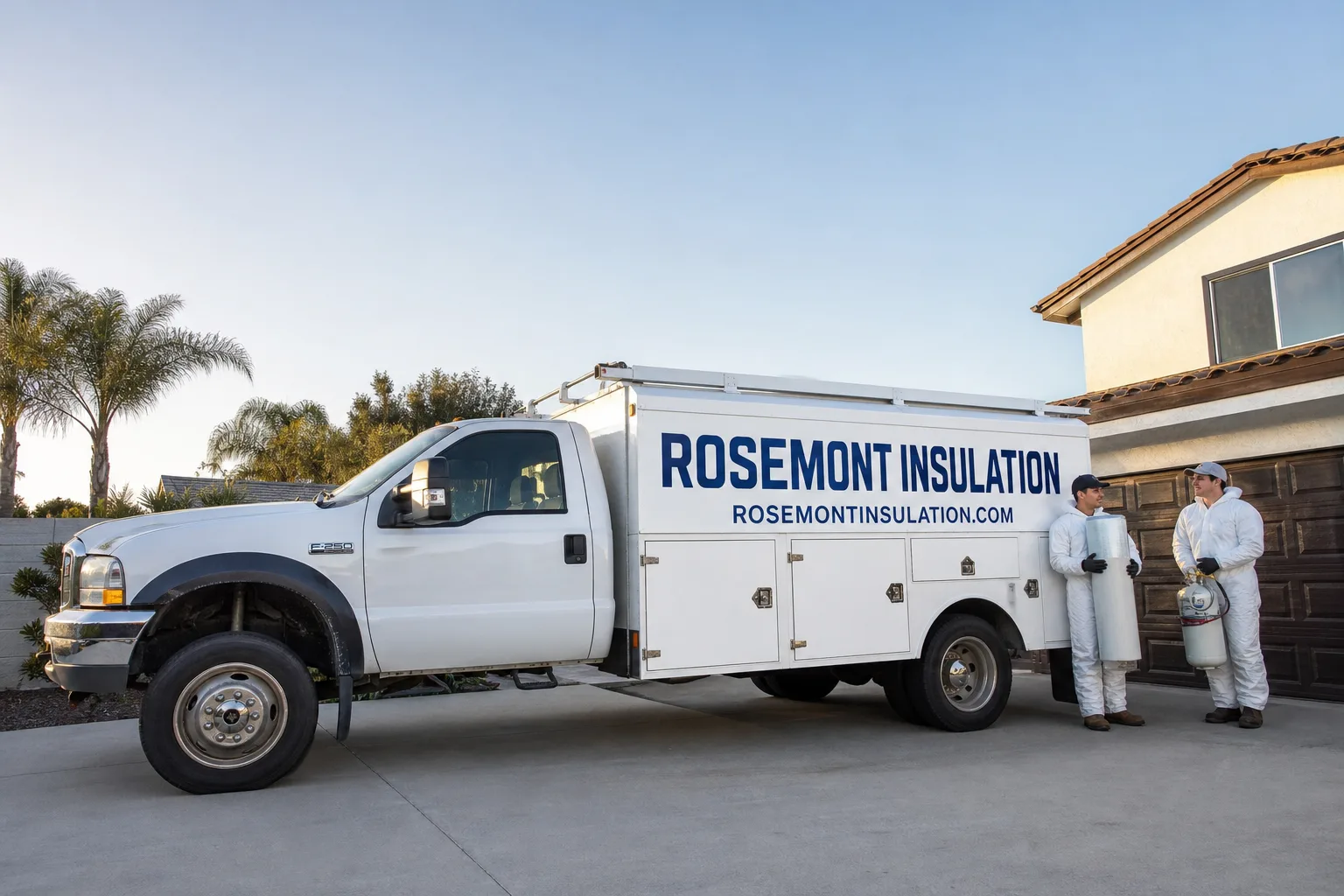
Fast, Reliable Spray Foam Insulation Across Fountain Valley
Spray foam insulation in Fountain Valley typically costs $2.50 to $6.50 per board foot installed, with most whole-attic jobs on the 1960s and 70s ranch homes here running $4,200 to $9,800. Our crews are in Fountain Valley two to three days a week, and we can usually schedule an estimate within 48 hours. You’re dealing with a specific housing stock here: post-WWII tract ranches, shallow side attics, low-pitch roofs, and walls that were built with little to nothing inside them. We know those homes because we work on them constantly. Call (877) 676-3859 for a free estimate, and we’ll walk your attic with you before we recommend anything.
Why Rosemont Insulation Is Fountain Valley’s Preferred Spray Foam Insulation Company
Fountain Valley homeowners call us because we don’t show up pushing one product. We carry eight insulation brands and install all three major methods, so the conversation starts with what your home actually needs, not what we happen to stock. That matters in Fountain Valley specifically because the housing stock is so uniform: single-story ranch and tract homes built between 1960 and 1975, many with original loose-fill attic insulation that has compacted to a fraction of its original R-value, and walls that were never insulated at all. We’ve worked in the tracts west of Brookhurst, over in the 92708 and 92728 ZIP codes, and around Mile Square Park enough to know exactly what we’ll find before we open the access hatch.
Noel Carrington leads our team, and he’s built the company around a material-agnostic approach. That means if spray foam isn’t the right call for your Fountain Valley home, we’ll tell you. But when it is, we’re certified to install Icynene and Demilec systems, two of the most performance-tested spray foam brands in the industry. Most local competitors don’t carry either one.
Spray Foam Attic Insulation in Fountain Valley
Spray foam attic insulation in Fountain Valley is typically a closed-cell application to the roofline, converting the attic into a conditioned space and sealing the rafter bays that the marine layer loves to work into. On the ranch homes that dominate this city, the attics are shallow and side-accessible, which means blown fiberglass alone often leaves eave gaps and top plates unsealed. That’s exactly where fog-belt moisture gets in. A typical attic job in Fountain Valley runs $4,200 to $8,500 depending on square footage and whether we’re removing old batts first.
Sealing the Rafter Bays
In a shallow side attic, the rafter bays are tight and irregular. Closed-cell foam fills those bays completely and creates an air seal that fiberglass physically cannot match. That seal matters more in Fountain Valley than it does six miles inland, because the morning marine layer pushes damp air into any gap it can find.
Dealing with Old Batts
Homes west of Brookhurst frequently still have the original fiberglass batts stapled to the underside of the roof rafters. In many cases those batts are sagging, blackened from trapped moisture, and doing more harm than good. We remove them, air-seal the top plates, and then spray the roof deck. Leaving them in place and spraying over them is how you get a musty attic that smells the same way a year later.
Spray Foam Wall Insulation in Fountain Valley
Spray foam wall insulation in Fountain Valley usually means injecting open-cell or closed-cell foam into the empty cavities of 1960s and 70s era walls that were built with R-0. These are the tract homes east of the 405 and south of the 22, and most of them have nothing between the drywall and the stucco. The symptom homeowners notice first isn’t heat, it’s cold morning drafts and a musty smell, because the coastal fog does more work on these walls than the summer sun. Wall injection jobs here typically run $5,500 to $12,000, depending on the number of exterior walls and the access we have.
Closed-Cell for the Fog Belt
We lean toward closed-cell foam for Fountain Valley walls because it acts as a vapor retarder. The marine layer sits on these homes most summer mornings, and open-cell foam will allow more moisture transfer than some homeowners want. Closed-cell also adds meaningful structural rigidity to older lumber.
Drill-and-Fill from the Exterior
For most ranchers, we drill through the stucco from the outside, fill the stud bays, and patch the holes. It’s cleaner than cutting drywall, and it lets us inspect the existing wall condition. If we find old newspaper or decomposed cellulose from a partial 1980s retrofit, we’ll show you before we proceed.
Trusted Brands We Service in Fountain Valley
We install Icynene and Demilec spray foam systems, and we carry them because they solve different problems. Icynene’s open-cell foam performs well for interior sound dampening and full-cavity fills where vapor permeability is fine. Demilec’s closed-cell products are what we reach for on Fountain Valley exterior walls and roof decks where moisture resistance matters. For homeowners weighing fiberglass or cellulose alongside spray foam, we also stock Owens Corning, GreenFiber, and Rockwool. Here’s the point: our Spray Foam Insulation team will show you the trade-offs honestly, because we have all the options on the shelf.
Common Spray Foam Insulation Problems We See in Fountain Valley Homes
- Spraying over moisture-blackened batts. In the tracts west of Brookhurst, we often find original batts sagging from the rafters and stained from years of fog-belt condensation. Any contractor who sprays foam over those batts without removing them first is sealing in the moisture, and the musty odor will be back before the next summer fog cycle.
- Skipping soffit baffling on low-pitch roofs. Fountain Valley’s ranch homes have shallow roof pitches, which means the eave vent path is already restricted. If foam is applied to the roof deck without installing baffles at the eaves, you choke the only venting the marine layer had, trapping damp air against the sheathing.
- Treating it as a heat-load job. Some companies sell spray foam in Fountain Valley the way they’d sell it in Riverside or Fontana, leaning hard on summer cooling costs. That misses the actual problem here. These homes feel mild in summer because of the coastal fog. The real issues are cold morning drafts, condensation in the walls, and musty attic smells.
- Ignoring the top plates. Even a good spray foam job underperforms if the top plates, those horizontal framing members where the walls meet the ceiling, aren’t air-sealed first. In a 60-year-old Fountain Valley rancher, the gaps there are large enough to see daylight through in some homes.
Pricing for Spray Foam Insulation in Fountain Valley, CA
Spray foam in Fountain Valley runs $2.50 to $6.50 per board foot installed, with the spread mostly coming down to open-cell versus closed-cell. A typical shallow attic roof deck on a 1,600 square foot rancher lands between $4,200 and $5,800 for closed-cell foam, including removal of old batts where needed. Full wall injection on a three-bedroom tract home runs $5,500 to $9,500. Homes in the 92728 ZIP code tend to be slightly larger and fall toward the upper end. Rim joist work, garage ceiling applications, and roof deck remediation will all shift the number. Estimates are free, and the quote we give you is the price you pay. Call (877) 676-3859 to schedule yours.
We Also Serve Cities Near Fountain Valley
Our crews cover Fountain Valley and the surrounding Orange County communities, including Midway City, Huntington Beach, Costa Mesa, and Westminster. If you’re in one of those areas and need Fountain Valley-level expertise on an older ranch home, we can help. Same scheduling process, same free estimate.
Serving Fountain Valley, CA — Our Local Coverage Area
We’re based in the Fountain Valley area and know this community well. Use the map below to see our service coverage — if you’re nearby, we can almost certainly help.
FAQs About Spray Foam Insulation in Fountain Valley
Spray foam makes more sense because it air-seals, and air-sealing is what your ranch home is actually missing. Blown fiberglass slows heat transfer but does nothing to stop the fog-belt air moving through your top plates, eave gaps, and empty wall cavities. In Fountain Valley’s shallow side attics, the rafter bays are small and irregular enough that fiberglass simply won’t close those paths. Foam fills and seals them in one pass. Call (877) 676-3859 and we’ll explain the difference in your actual attic.
No, we remove them first. That’s not a sales tactic, it’s a moisture decision. On a 1968 tract ranch west of Brookhurst, our crew opened a shallow side attic and found the original batts stapled to the roof rafters with no baffles at the eaves, sagging, blackened, and trapping moisture. Spraying foam over that condition seals in the dampness. We remove and dispose of the old batts, air-seal the top plates and eave gaps, install proper soffit baffling, and then apply the foam. You get one clean, dry assembly instead of a sealed-in problem.
Yes, and that’s actually the most common reason Fountain Valley homeowners call us about wall insulation. The musty smell usually comes from warm, moist exterior air hitting the cool interior wall cavity during foggy mornings, condensing, and sitting there. Closed-cell spray foam fills the cavity and stops that air movement entirely. If your home is a 60s-era tract rancher with original R-0 walls, this is very likely your culprit. Call (877) 676-3859 for an inspection.
Yes, absolutely. A low-pitch Fountain Valley roof has a very short rafter bay, so the eave vent does most of the work it’s going to do in a limited space. When you spray foam directly against the roof deck, you’re closing off the attic’s connection to that vent path. Baffles, those lightweight channels we install at the eaves before spraying, keep a dedicated air channel open from the soffit to the ridge. Skip them and you’ll trap marine-layer moisture against the sheathing.
For most Fountain Valley homes, it’s not overkill, because the problem isn’t heat, it’s moisture and air movement. A home three miles inland might buy spray foam to cut AC bills. Your home needs it to stop fog-belt condensation from soaking the wall cavities and attic every summer morning. That’s a different job with a different payoff: fewer drafts on cool mornings, no musty bedroom smell, and an attic that doesn’t feel damp when you open the hatch. The R-value is a bonus, not the point.
Get a Free Spray Foam Insulation Estimate in Fountain Valley
If your Fountain Valley home has cold drafts, a musty attic, or utility bills that don’t match the mild coastal climate, we’ll diagnose it honestly. Noel Carrington and the Rosemont Insulation team work in Fountain Valley every week. We’ll inspect your attic and walls, show you what we find, and quote a price that won’t change. Call (877) 676-3859 to schedule your free estimate.
Written by Noel Carrington, Owner at Rosemont Insulation, serving Fountain Valley and greater Orange County.