
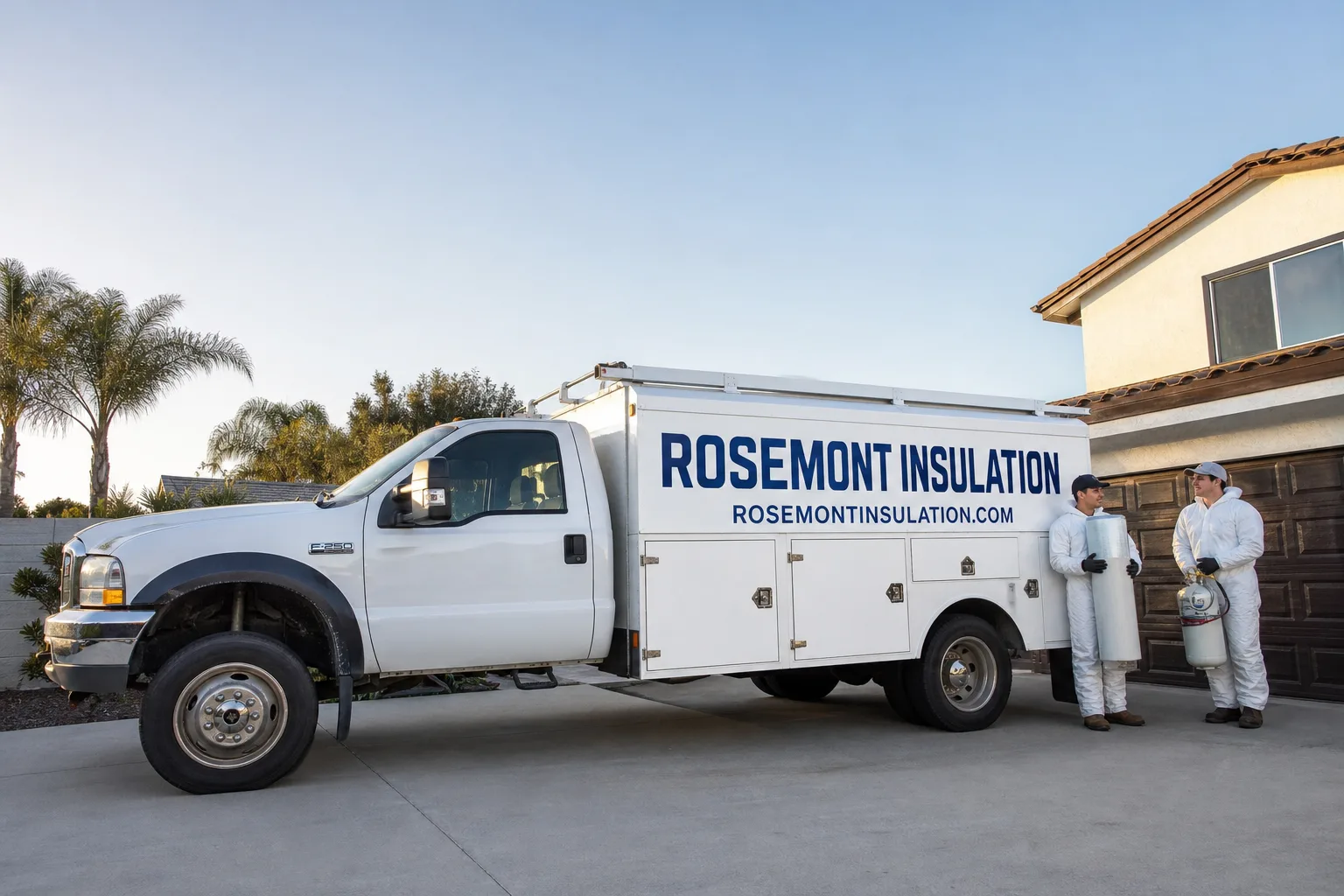
Fast, Reliable Attic Insulation Across La Palma
Attic insulation in La Palma is almost always a retrofit job. The city’s 1965 – 1980 tract homes were built with R-11 or R-13 batt insulation that has since settled, compressed, or been pulled apart by decades of rewiring and HVAC work. Most attics we test in La Palma now measure R-8 or lower. That’s less than a third of what the Department of Energy recommends for this climate zone, and it’s why summer cooling bills here run so much higher than they should. We’re Rosemont Insulation, and we work in La Palma every week. Call (877) 676-3859 for a free attic assessment.
What makes La Palma different from neighboring Cerritos or Cypress isn’t the housing style. It’s the combination of a built-out 1960s-70s master-planned layout, the city’s strict exterior-alteration rules, and the marine layer that rolls in most mornings. Those three factors shape how we insulate attics here, and they’re the reason you want a crew that already knows the tract layouts, the eave vent limitations, and the permit expectations before they pull up to your house.
Why Rosemont Insulation Is La Palma’s Preferred Attic Insulation Company
Homeowners in La Palma don’t need a sales pitch. They need someone who can look at a shallow attic off Walker Street or a two-story townhome near La Palma Avenue and immediately know where the heat is getting in, where the moisture is collecting, and which of the eight brands we carry will actually solve the problem. That’s the work we do.
La Palma is a small city: one ZIP code, 90623, roughly 4,800 homes, nearly all of them built between 1965 and 1980. We’ve worked on enough of those homes to recognize the original builders’ insulation patterns before we even open the hatch. And because we’re based in nearby Costa Mesa, our response time to La Palma is typically same-day or next-day for assessments. If your attic is reading 140 degrees in August and your upstairs won’t cool below 80, we can be there fast.
Rosemont Insulation is led by Noel Carrington, who built the company around a simple principle: carry the right material for the home, not just the one that’s easiest to stock. For La Palma’s shallow, low-pitch attics and salt-air exposure, that often means blown-in fiberglass from Knauf or CertainTeed, paired with a radiant barrier and upgraded eave ventilation. The Attic Insulation team we send to La Palma has seen every failure mode this housing stock can produce.
Attic Ventilation in La Palma
Attic Ventilation in La Palma addresses a specific problem: marine-layer moisture that condenses inside under-ventilated attics every morning from May through October. A 1968 tract home with the original eave vents often has half the airflow it needs, and when warm attic air meets that cool, damp marine layer, condensation forms on rafters, settles into insulation, and gradually degrades R-value while inviting mold. Proper ventilation fixes this by moving air through the attic continuously.
When we assess a La Palma attic, we check vent types, vent spacing, and whether decades of paint or stucco work have partially sealed the original slots. The fix ranges from cleaning and restoring existing eave vents to adding soffit or ridge vents, depending on what the architectural-review rules allow. In La Palma, most ventilation work runs $350 to $1,200, depending on the number of vents and whether we’re adding baffles to keep new insulation from blocking airflow.
Eave Vent Restoration
Older La Palma homes frequently have eave vents that were painted over during an exterior refresh, cutting airflow by 50 percent or more without the homeowner ever noticing. Restoring them is low-cost, low-disruption work. We clear the slots, install baffles where needed, and verify airflow with a smoke test before we leave.
Baffle Installation and Airflow Correction
When we blow in new insulation, we always install baffles first. Without them, loose-fill blocks the eave vents and traps moisture exactly where you don’t want it. In La Palma’s narrow 1960s vent slots, this requires careful pressure control and shorter hose runs than we’d use in a newer home with full ridge ventilation.
Radiant Barrier in La Palma
Radiant Barrier in La Palma matters because this city’s cooling load dominates the energy equation. Summer highs in inland North Orange County routinely cross 90 degrees, and the sun beats directly on thousands of low-pitch roofs that transfer that heat straight into the attic. A radiant barrier reflects that radiant heat before it soaks into your insulation and ductwork. For a La Palma homeowner running air conditioning from June through October, it’s the single highest-return attic upgrade available.
We install radiant barrier as a foil-facing layer attached to the underside of the roof deck or draped over existing insulation. In La Palma’s shallow attics, deck installation is usually the better choice because loose-fill coverage is often too thin to support a drape. The cost depends on attic size and accessibility, but most La Palma installations run $1,500 to $3,200 for a typical 1,200 to 1,800 square-foot home.
Deck-Attached Radiant Barrier
This method staples the foil to the rafters, creating a continuous reflective surface that blocks up to 97 percent of radiant heat transfer. It works well in La Palma because our attics are almost uniformly low-pitch, which means the roof deck sits close to the living space and radiated heat moves straight through.
Radiant Barrier Over Blown-In Insulation
In some La Palma attics with enough depth, we can drape radiant barrier over the insulation itself. This is marginally less effective than deck attachment but costs less to install. We’ll only recommend it where the attic floor can support the material without compressing the insulation below it.
Trusted Brands We Service in La Palma
We stock materials for La Palma jobs before we arrive, which keeps turnaround tight. For blown-in attic work, we carry Knauf and CertainTeed fiberglass, both of which hold their loft better than the original loose-fill that’s currently sitting in most of these attics. For homes where salt-air moisture is a factor, we use Rockwool mineral wool in wall cavities: it resists moisture and won’t support mold the way old batts can. And for high-performance air-sealing in conditioned attics, we install Icynene spray foam, a brand most La Palma contractors don’t even stock. Eight brands, three methods, one Rosemont crew.
Common Attic Insulation Problems We See in La Palma Homes
- Settled original loose-fill reading R-8 or less. The 1965 – 1980 tract homes across La Palma were insulated to 1960s code, which is nowhere near today’s standard. In the shallow attics near Walker Street and Houston Avenue, years of foot traffic from cable installers and HVAC techs have compressed what little insulation was there.
- Marine-layer moisture condensing in under-ventilated attics. La Palma sits close enough to the coast that morning fog is a regular visitor. When that moist air meets a hot attic without adequate eave ventilation, condensation forms and batts begin to degrade, losing R-value while creating conditions mold loves.
- Blocked eave vents from paint or blown-in insulation. We see this constantly: homeowners who had insulation added years ago without baffles, and now the loose-fill has slumped directly over the eave vents, cutting airflow to near zero and trapping heat and moisture in the attic.
- Radiant heat gain through low-pitch roofs. La Palma’s original roof designs put the deck close to the ceiling, and without a radiant barrier, summer attic temperatures regularly hit 140 degrees. That heat soaks through the ceiling and drives your air conditioner to work far harder than it should.
Pricing for Attic Insulation in La Palma, CA
Attic insulation pricing in La Palma tracks the city’s housing stock: shallow attics, small lots, and restrictive access all shape the final number. A basic attic top-up with blown-in fiberglass runs $1,200 to $2,800 for a typical 1,200 to 1,500 square-foot home. Full attic insulation replacement, including removal of old material, baffle installation, and new blown-in insulation to R-38, runs $2,800 to $6,500 depending on attic depth and whether we’re working through eave vents or a standard access hatch. Adding a radiant barrier typically runs $1,500 to $3,200. Attic ventilation work runs $350 to $1,200.
Yes, cheaper crews exist. They blow in insulation without baffles, skip the moisture assessment, and don’t stock the brands we carry. If you want it done once and done right, call (877) 676-3859 for a free estimate. We’ll give you the number before we start.
We Also Serve Cities Near La Palma
Most of our La Palma work comes from referrals in the surrounding communities. We regularly serve Attic Insulation in La Palma and the neighboring cities of Cerritos, Cypress, Buena Park, and Hawaiian Gardens. If you’re in one of those areas and your attic is running hot, the same crew and the same eight-brand lineup are available to you.
Serving La Palma, CA — Our Local Coverage Area
We’re based in the La Palma area and know this community well. Use the map below to see our service coverage — if you’re nearby, we can almost certainly help.
FAQs About Attic Insulation in La Palma
Salt air doesn’t directly damage attic insulation, but it corrodes the fasteners, vent screens, and any metal components in the attic assembly. In practice, that means older eave vents in La Palma are often rusted through or seized, and we replace them as part of any insulation upgrade. It’s also why we prefer Rockwool mineral wool in wall cavities here: it resists moisture and won’t degrade the way fiberglass batts do when exposed to condensation. Call (877) 676-3859 and we’ll assess your attic’s specific condition.
Yes. Because La Palma’s architectural-review rules restrict roof changes, we routinely blow in insulation through the existing eave vents rather than cutting new access holes. It’s a slower, more careful process that preserves the home’s low-pitch roofline and stucco profile. The technique demands precise pressure control so the narrow 1960s-era vent slots don’t clog, but our crews have done it on hundreds of La Palma homes. A free assessment will tell you if your attic qualifies.
For La Palma’s climate, we recommend R-38 to R-49 in the attic. Most homes here currently sit at R-8 to R-13, so the gap is significant. The exact number depends on your home’s orientation, attic depth, and whether you’re also adding a radiant barrier. We’ll give you a specific recommendation when we assess your attic, and the estimate is free when you call (877) 676-3859.
Attic ventilation prevents the condensation that La Palma’s morning marine layer produces inside under-ventilated attics. Warm attic air meets cool, damp air from the coast, and moisture forms on rafters and insulation. Over time this degrades R-value and invites mold. Proper eave-to-ridge airflow stops this cycle. In older La Palma tract homes, restoring painted-over eave vents is often the single most effective upgrade we make.
We recommend checking garage-door springs, hinges, and opener chains once a year in La Palma. Salt air corrodes these parts years faster than inland, and failures are often misattributed to insulation gaps. During a recent job on a 1968 tract home near Walker Street and La Palma Avenue, we found a seized opener chain from salt-air exposure alongside settled attic insulation reading R-8. Both got replaced the same day. If you hear grinding or see rust on your hardware, call (877) 676-3859 and we’ll include it in your attic assessment.
Written by Noel Carrington, Owner at Rosemont Insulation, serving La Palma and surrounding Orange County communities.